Introduction: The Right Tools for the Right Job
Opening a modern smartphone in 2026 requires far more precision than it did a decade ago. With OLED displays glued tightly to frames, microscopic 01005-sized components, and heavily encrypted batteries, relying on cheap, generic hardware-store tools will result in damaged devices and lost profit.
Whether you are just starting a mobile repair business or upgrading your professional workstation, investing in specialized equipment is non-negotiable. True mobile repair tools use hardened steel, laser-calibrated tips, and ergonomic designs built for micron-level tolerances.
In this guide, we break down the 15 essential tools every phone repair tech needs, categorized by their function. More importantly, we will cover the digital tool you need to track the revenue generated from your hardware: RepairNest POS.
Category 1: Mechanical Disassembly and Opening Tools
As the internal structures of mobile phones become increasingly intricate, forceful disassembly carries a high risk of shattering the screen or severing flexible ribbon cables.
-
Precision Screwdriver Set
To handle the pentalobe screws found in iPhones (like the 0.8mm P2), as well as the Phillips and Tri-point (Y-type) screws in Android devices, you must employ precision screwdrivers characterized by high hardness (S2 tool steel) and appropriately calibrated magnetic strength. Avoid cheap bits that wear faster and round out screws.
-
Non-Marring Plastic Pry Tools (Spudgers)
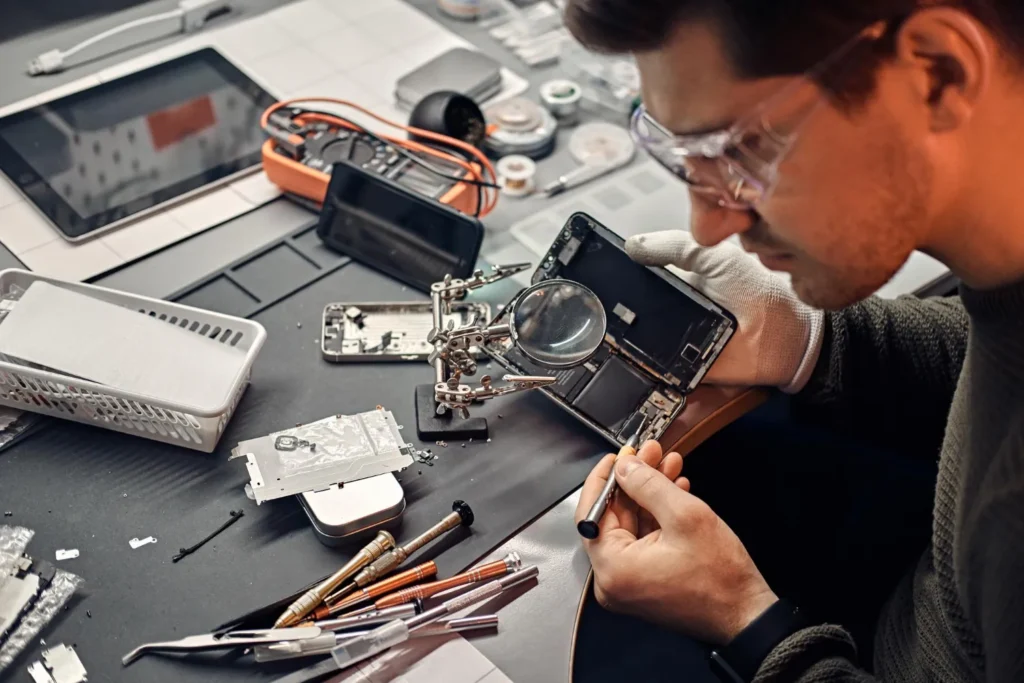
Metal tools will scratch painted chassis and short out live logic boards. High-quality nylon spudgers and plastic guitar picks are essential for safely disconnecting battery terminals and lifting delicate flex cables.
-
Magnetic Project Mat
Losing a 1.2mm screw will halt a repair completely. A magnetic mat allows you to trace and hold screws in the exact orientation they were removed, ensuring every piece goes back precisely where it belongs.
-
Suction Cups & Display Pliers
For separating tightly adhered OLED screens from frames, specialized suction cup pliers (like the iSclack) apply even, controlled pressure, minimizing the risk of cracking the glass during opening.
Category 2: Diagnostic and Testing Instruments
Modern mobile phone faults are often concealed within complex logic circuits. They cannot be diagnosed by the naked eye alone and therefore require reliance on high-precision measurement tools.
-
High-Precision Digital Multimeter
The multimeter serves as the starting point for circuit diagnosis. Advanced multimeters in 2026 feature ultra-fast continuity buzzer response times and exceptional precision in resistance measurement, crucial for finding shorts on a motherboard.
-
Regulated DC Power Supply
A DC Power Supply not only provides simulated battery power to the mobile phone, but the fluctuation curve of its current output also serves as a critical basis for diagnosing the nature of a fault. Setting the supply to the phone’s nominal voltage (typically 3.8V–4.2V) allows technicians to observe the current’s behavior during the power-on sequence.
-
Intelligent Battery Tester & Programmer
With the advancement of battery encryption technologies, simply replacing the internal battery cell is no longer sufficient. A battery tester is used to read data from the original cell (such as cycle count and remaining capacity percentage) and transfer this information to the control board of the new battery.
-
Trinocular Stereo Microscope
This is the standard equipment for a professional repair workstation in 2026. It provides clear images with continuous zoom capabilities and simultaneously mirrors the live feed onto a large external monitor, reducing eye strain and allowing for precise micro-soldering.
Category 3: Heating and Soldering Equipment
Whether replacing aging capacitors or reballing tiny BGA chips, the performance of your soldering tools directly determines the success rate of the repair.
-
Intelligent Hot Air Rework Station
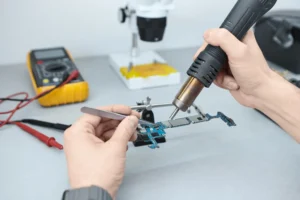
The hot air gun is the quintessential tool for the removal of Integrated Circuits (ICs) and charging ports. Mainstream equipment in 2026 features linear adjustment capabilities for both airflow and temperature, preventing heat damage to surrounding components.
-
High-Frequency Soldering Station
A professional anti-static soldering station with digital temperature control and an induction-based sleep mode is vital. Paired with ultra-fine tips, it allows technicians to jump broken tracks and replace micro-components safely.
-
LCD Heating Separator Machine
To soften the strong adhesives holding back glass panels and screens, a heating pad or separator machine provides consistent, safe, and evenly distributed heat, replacing the outdated and risky use of standard heat guns for general adhesive removal.
-
High-Quality Flux and Soldering Paste
Quality liquid and paste flux ensure smooth solder joints and prevent oxidation during high-heat micro-soldering tasks. Never skimp on your consumables.
Category 4: Cleaning and Safety Equipment
A clean workspace is a safe workspace. Contaminants and static electricity are invisible killers of electronic components.
-
Comprehensive Anti-Static (ESD) System
Even a minuscule electrostatic discharge can cause a dielectric breakdown within an integrated circuit (IC). You must equip your bench with an ESD-safe grounding mat, anti-static wrist straps, and ESD-safe tweezers.
-
Isopropyl Alcohol (IPA) & PCB Cleaners
Flux residues left on circuit boards are acidic in nature; if allowed to persist over time, they can corrode the circuitry. High-purity IPA (99%) and specialized PCB cleaning brushes are required to scrub boards after water damage treatments and soldering jobs.
Category 5: The Ultimate Software Tool
-
Repair Shop Management POS (RepairNest)
You can have the most advanced microscope and soldering station in the world, but if you cannot track your inventory, manage customer tickets, or calculate your profit margins, your business will fail.
RepairNest POS is the ultimate digital tool for your repair bench. It replaces messy paper tickets and generic retail software with a system built specifically for electronics repair. RepairNest features mandatory digital intake checklists (ensuring you document pre-existing damage before using your pry tools), automated part deduction (so you never run out of screens), and automated customer SMS updates (so you can focus on the repair, not answering the phone).
Conclusion: Build Your Bench for Success
Investing in the right physical tools reduces your liability, speeds up your repair times, and ensures high-quality results for your customers. From precision screwdrivers to high-frequency hot air stations, your equipment defines your capability.
Once your physical bench is built, secure your operational workflow with RepairNest POS, ensuring every repair translates into organized, measurable profit.