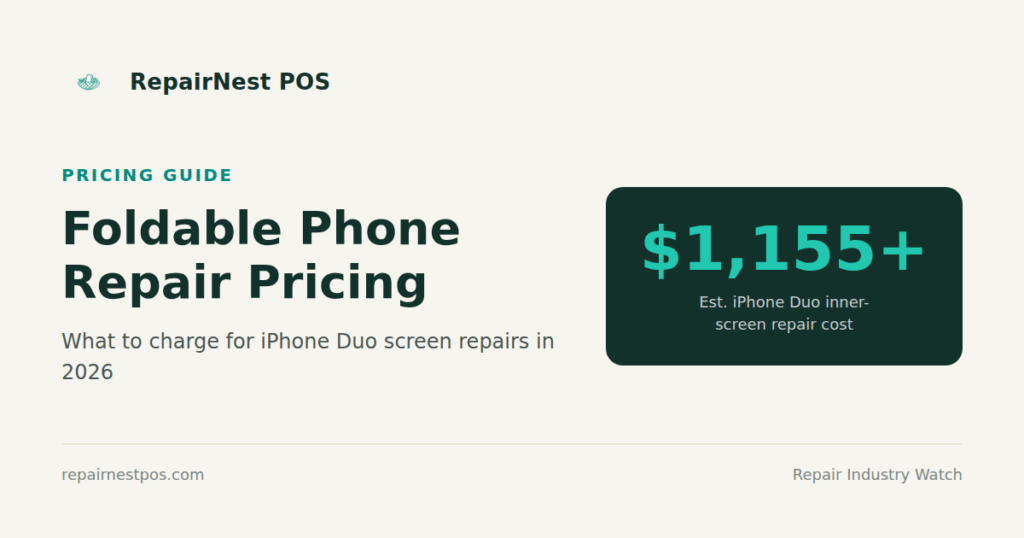
Apple’s first foldable, the iPhone Duo, is already reshaping the conversation at repair counters. Early industry estimates put a full inner-display replacement north of $1,155 — and that number alone should have every repair shop owner rethinking how they price foldable repairs, not just for this device but for the wave of dual-screen phones that will follow it.
If your shop is still quoting foldables the same way you quote a standard cracked screen, you’re either leaving money on the table or scaring away customers with a number you can’t justify. Here’s how to think about it instead.
What the iPhone Duo Actually Costs to Repair
Pre-launch estimates from repair-industry analysts put the iPhone Duo’s inner-display replacement at $1,155 or more — roughly 58% of the phone’s own $1,999 starting price. For comparison, replacing the inner screen on Samsung’s Galaxy Z Fold 8 runs closer to $579. That’s nearly double the repair cost for Apple’s foldable, driven by the dual 7.6″ and 5.4″ Super Retina XDR displays, the titanium hinge assembly, and tighter parts availability in a first-generation device.
Those figures will move once the device is in the wild for a few months and aftermarket parts catch up — but the underlying lesson won’t change: foldables cost meaningfully more to fix, and your pricing needs to reflect that from day one.
Why Foldable Repair Pricing Isn’t Just “A Bigger Screen”
A lot of shops make the mistake of pricing a foldable repair the way they’d price any other screen job — parts cost plus a flat labor fee. That formula breaks down fast on a foldable, for a few reasons:
- Two displays, not one. Damage to the outer cover screen doesn’t always mean the inner flexible display is fine, and vice versa — diagnosis takes longer because you’re evaluating two separate panels and the hinge that connects them.
- The hinge assembly is its own repair. Foldables rely on precision hinge mechanisms that are expensive to source and unforgiving to install. A misaligned hinge can crack a brand-new replacement display on reassembly.
- Flexible OLED panels are fragile to handle. The inner display on a foldable is thinner and more prone to damage during removal than a standard rigid screen, which raises your risk of an in-shop mistake.
- Parts are scarcer and pricier early on. First-generation parts supply chains are thin. Expect to pay more per part and wait longer for it, especially in the first several months after launch.
Every one of those adds real time and real risk to the job — and both need to show up in your price.
A Simple Framework for Pricing Foldable Repairs
Instead of guessing, build your foldable price the same deliberate way you’d price any high-risk, high-skill repair. Four inputs:
- Parts cost. The actual cost of the display, hinge components, and adhesives, plus shipping if you’re sourcing from a specialty supplier.
- Labor time × your shop rate. Foldable teardown and reassembly typically takes noticeably longer than a standard screen swap — price the real hours, not the hours you wish it took.
- A risk/warranty buffer. Build in a cushion for the higher callback risk on flexible displays and hinge work. If you’re offering a warranty on the repair, this buffer is what protects your margin if something needs a second pass.
- Your margin. The same margin discipline you’d apply to any repair — don’t let the intimidating parts cost talk you into working for free on the labor.
Worked example: if the inner display costs you $650, the job runs 2.5 hours at a $75/hour shop rate ($187.50), and you build in a 10% risk buffer and a 20% margin, you’re looking at a quote in the neighborhood of $1,050–$1,100 — which lines up closely with the early industry estimates for this device. That’s not a coincidence; it’s what the job actually costs to do right.
Don’t Forget the Hidden Costs
A few line items that are easy to underprice or skip entirely:
- Diagnostic time. Confirming whether it’s the outer glass, the inner panel, or the hinge causing a fault takes longer on a two-screen device. Charge for it, or build it into your base quote.
- Technician training. Foldables are a different skill set. If you’re investing in training or new tools to handle them safely, that cost has to be recovered somewhere.
- Tool investment. Specialty fixtures and heating tools for hinge work aren’t cheap, and they’re not optional if you want consistent results.
Why Tracking Matters More With Foldables
Foldable repairs also raise the stakes on your back-office tracking. With more expensive parts, longer repair tickets, and higher customer expectations, a shop running on a generic retail POS — or a spreadsheet — is going to lose money to untracked parts, missed IMEI records, or a warranty claim nobody can verify.
A repair-focused POS system tracks the part, the IMEI, the technician, and the repair history against every ticket automatically — so when a customer calls back about their $1,100 hinge repair six weeks later, you have the answer in seconds instead of digging through paper tickets. It’s also worth revisiting how your POS reporting can show you whether your foldable pricing is actually profitable once labor and callbacks are accounted for, rather than just going on gut feel.
Frequently Asked Questions
How much does it cost to repair a foldable phone screen?
Early estimates put an iPhone Duo inner-display replacement at $1,155 or more, versus roughly $579 for a Samsung Galaxy Z Fold 8. Costs vary by shop, region, and parts availability.
Is it worth repairing a foldable phone instead of replacing it?
In most cases, yes — a $1,000–$1,200 repair is still meaningfully cheaper than a $1,999+ replacement device, which is exactly the value proposition repair shops should be leading with.
Should repair shops raise prices specifically for foldable devices?
Yes. Foldable repairs involve more diagnostic time, pricier and scarcer parts, and higher technical risk than a standard screen replacement, and your pricing should reflect all three.
The Bottom Line
The iPhone Duo is the first of many foldables your shop will see walk through the door. Get your pricing framework right now — parts, labor, risk, and margin — and you’ll be ready for every dual-screen device that follows it, instead of scrambling to figure out a fair price on the fly.